































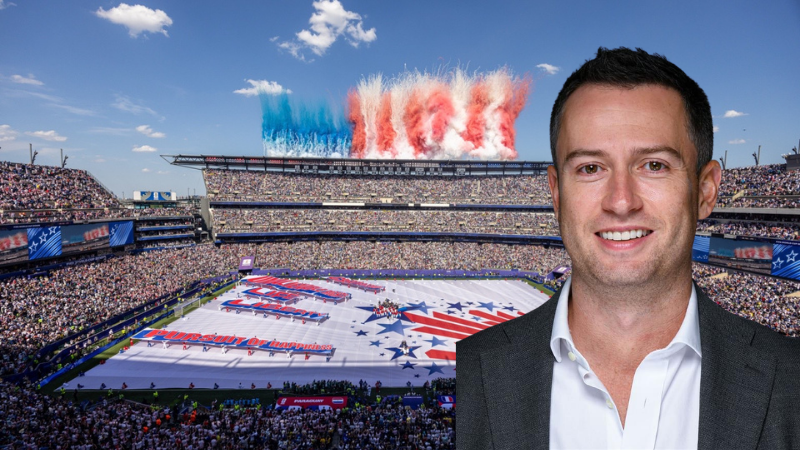
Ross McCall has spent the better part of a decade inside FIFA, starting in 2018 as head of brand strategy and business intelligence just before the Russia World Cup. In that role, he helped build the data infrastructure that reshaped FIFA’s commercial rights framework, work that fed directly into how the organization prices partnerships, evaluates sponsor performance, and proves ROI to brands writing nine-figure checks.
Today, as Executive Director of Commercial Operations for FIFA World Cup 2026, McCall’s remit spans brand, marketing, licensing, retail, host city relationships, fan festival programming, and partnership activation across the United States, Canada, and Mexico.
YOU OVERSEE COMMERCIAL OPERATIONS ACROSS 16 HOST CITIES AND THREE COUNTRIES. WALK US THROUGH YOUR ROLE.
McCall: My remit spans brand, marketing, licensing, and retail, all of our host city relationships across the three countries, our fan festival projects, and all of our partnership activations. That means making sure our commercial partners’ rights are activated and delivered effectively across the tournament. I’m based in Miami, our main headquarters, but I’m also overseeing delivery in Canada and Mexico and across all 16 host cities.
LET’S TALK NUMBERS. HOW MANY PEOPLE ARE EXPECTED TO WATCH THE 2026 WORLD CUP?
McCall: We had about 5.5 billion people watch across the 2022 tournament, and we expect more for 2026. For context, the Super Bowl draws somewhere between 160 and 190 million from a global audience perspective. Our 2022 Final alone generated 1.5 billion viewers for a single match. The demographic split surprises people too: it’s nearly even between male and female viewers, with a huge concentration of interest among Gen Z and millennials.
YOU STARTED AT FIFA IN BUSINESS INTELLIGENCE BEFORE MOVING INTO COMMERCIAL OPERATIONS. HOW DID THAT JOURNEY UNFOLD?
McCall: I joined in 2018, just before the Russia World Cup, with a mandate to build out FIFA’s intelligence infrastructure. We were sitting on a huge amount of data, market research, fan and partner insights, but it wasn’t really being used to drive decision-making. My job was to change that: how do we price rights correctly, how do we evaluate partner performance, how do we understand what a market is actually worth. That analytical foundation fed directly into restructuring our commercial rights framework. Once you understand the numbers deeply enough, you stop just advising on decisions and start being accountable for them. That’s how the move into operations happened.
FOR 2026, FIFA MADE THE DECISION TO BRING EVENT DELIVERY IN-HOUSE FOR THE FIRST TIME RATHER THAN USING A LOCAL ORGANIZING COMMITTEE. WHY?
McCall: It was a significant operational bet, but it’s worked out. Bringing it in-house gave us faster decision-making and direct control over what the product looks like. The World Cup is our golden goose, so it mattered that the standards and delivery were entirely up to FIFA’s own bar. That’s not a knock on past local organizing committees, they’ve done fantastic work, but taking that burden on ourselves meant we could guarantee the end product was exactly what we wanted it to be.
MOST PEOPLE THINK OF THE WORLD CUP AS A SINGLE EVENT EVERY FOUR YEARS. WHAT DOES THE FULL CALENDAR ACTUALLY LOOK LIKE, AND WHERE DOES THE MONEY GO?
McCall: We work in four-year cycles culminating in the FIFA World Cup. We also run the Women’s World Cup on its own four-year cycle, next up in 2027 in Brazil. There’s the Men’s Club World Cup, a new tournament we introduced in 2025 here in the US, plus a Women’s Club World Cup launching soon, youth soccer, beach soccer, futsal, and regional tournaments. Across a four-year period, FIFA puts on 25 tournaments total, though the billions of viewers we talk about refer to the men’s World Cup alone. As for the money: we’re a not-for-profit, and a hundred percent of what we generate gets reinvested into world football through our 211 member associations, funding grassroots programs, infrastructure, and women’s football strategies. That’s a different mandate than a for-profit league like the NFL or the Premier League.
WALK US THROUGH HOW THE SPONSORSHIP TIERS WORK. WHAT DOES A BRAND ACTUALLY BUY?
McCall: We have a three-tiered structure. At the top is the FIFA Partner level, which buys global category exclusivity across all 25 tournaments in the cycle. Visa, for example, owns the payment services category globally, so we wouldn’t go to Mastercard or American Express for any FIFA rights. Below that is the World Cup Sponsor tier, which buys those same global rights but just for the Men’s World Cup. The third tier is Tournament Supporter, which buys geographic rights rather than global ones, so a brand might pick up North America, or North America plus Asia, and can only activate within those markets.
Who sits where is public. At the FIFA Partner level we have Adidas and Coca-Cola, among others. At the World Cup Sponsor level we have Michelob Ultra and McDonald’s. At the Tournament Supporter level we have Home Depot and Marriott. The 16 global-level positions sold out last month. We have a couple of Tournament Supporter spots left to fill before kickoff.
HOW MANY TOTAL SPONSORSHIP POSITIONS DOES FIFA SELL, AND HAS THAT NUMBER CHANGED OVER TIME?
McCall: We have 30 total positions, 16 global and 14 Tournament Supporter. We’ve kept that fairly tight intentionally, actually decreasing it from 34 in a previous edition, because a more condensed roster drives more value for each brand and lets us command a higher rights fee when you’re one of a select few rather than one of fifty. We also moved away from a one-size-fits-all model. The FIFA Partner tier still gets everything, but we created separate vertical structures for women’s football, club football, and e-football and gaming, so a brand that wants to invest specifically in the women’s game, but maybe can’t write a check at the full FIFA Partner level, now has a path in.
WHO MAKES THE DECISION ON THE BRAND SIDE WHEN A NEW PARTNER COMES IN?
McCall: It usually starts as a mandate from the CMO, who deploys their team or an agency to explore what’s out there. We’re typically engaging at the VP or SVP level in marketing, with the CMO across all of it, but unlocking hundreds of millions of dollars requires company-wide buy-in. That decision goes up to the CEO and the board. People assume selling the World Cup is easy because everyone wants in, but there are real internal hurdles to clear before that investment gets unlocked.
HOW DOES FIFA HANDLE BRANDS THAT TRY TO ASSOCIATE THEMSELVES WITH THE WORLD CUP WITHOUT PAYING FOR THE RIGHTS?
McCall: The more interest in the tournament, the better, but we protect our actual partners fiercely, because they’ve paid a huge amount of money for that exclusivity. Our IP legal team monitors constantly, and so do our partners themselves. World Cup is a trademarked term, along with our logos and design identities. If you want to host a public watch party and you’re not an official partner, you can’t use the words FIFA or World Cup, you’d use something like Soccer Celebration instead, similar to how the NFL handles the term Super Bowl.
HOW DOES THAT PLAY OUT PHYSICALLY, GIVEN FIFA DOESN’T OWN THE STADIUMS AND THOSE VENUES HAVE THEIR OWN NAMING AND POURING RIGHTS DEALS?
McCall: We have to convert the entire stadium. If Coke is a World Cup sponsor and we’re playing in what’s normally a Pepsi venue, Pepsi’s pouring rights aren’t valid during the tournament. Existing Pepsi-branded equipment gets removed, and Coke brings in its own. Most commercial contracts for these venues include a World Cup clause that allows for exactly this kind of clean-site requirement without the venue’s existing sponsor incurring a penalty. We’re playing in a lot of NFL stadiums, so there’s also league branding. Even stadium naming rights can be affected.
HOW IS FIFA USING DATA AND AI TO DRIVE THE COMMERCIAL SALES PROCESS TODAY?
McCall: We run global fan surveys and market research around fandom, awareness, and propensity to purchase. We track social following and audience measurement down to the demographic splits behind a number like 1.5 billion viewers for a Final. LED visibility is one of the biggest assets we sell, so we track brand exposure throughout the broadcast too. When we sit down with a company like Coca-Cola, we use that data to build a case for why sponsoring the World Cup will outperform other media spend. On AI, I think we’re only scratching the surface. It helps us process data that used to be a manual lift, but where it’s really moving the needle is personalization, including on the broadcast side, where a second-screen experience could eventually speak differently to a fan in Manila than to one in London or Rio de Janeiro.
THE WORLD CUP HASN’T BEEN PLAYED IN AMERICA SINCE 1994. WHAT DOES FIFA SEE FOR THE LONG TERM IN THIS MARKET?
McCall: We view North America as a huge growth opportunity. We’re probably the fourth-largest sport in this market right now. That’s why we’re keeping a permanent office in Miami rather than hosting the tournament and leaving. We announced just yesterday that the Women’s Champions Cup will take place in Miami in January, and the Women’s World Cup in 2031 is more than likely coming back to the US as well. And I wouldn’t discount the women’s game in that growth story. In North America specifically, women’s soccer is actually more popular than men’s. The US women’s national team has been hugely successful, and everyone loves a winner.
IF YOU COULD SIT DOWN FOR DINNER WITH ANY BRAND LEADER, WHO WOULD IT BE AND WHAT WOULD YOU WANT TO ASK?
McCall: A bit of a left-field one, but the CMO of Netflix, Marian Lee. Netflix bought the Women’s World Cup rights from FIFA for 2027 and 2031, so we’ll be working closely with them, but what really interests me is the pivot itself. They spent a decade building the most sophisticated on-demand content business in the world, then systematically went after live sports, WWE, NFL Christmas Games, and now FIFA Women’s World Cup rights. I’d love to sit down with her and understand what it took to change that thinking internally and drive it through the organization.
The Marketer’s Collective connects leading marketers to inspire collaboration, ignite innovation, and drive strategic partnerships. Each month, a virtual event brings together a diverse slate of C-suite speakers from Fortune 500 brands, offering valuable insights and networking opportunities. For more information visit: themarketerscollective.com