




























If nearly anything you want can be delivered to your door within a day, what role does physical retail still play?
For years, retailers and developers have been trying to answer that question the wrong way. As e-commerce reshaped consumer habits and Amazon expanded its reach, the instinct was to compete on the same battlefield — more products, faster fulfillment, and endless convenience.
But that battle was lost the moment the internet became the most efficient store in the world.
The future of retail isn’t about competing with online shopping. It’s about offering something the internet can never replicate: shared human experience.
Physical retail’s greatest advantage is simple — it brings people together in the real world.
Retail used to be about transactions. The future of retail is about memories.
As our lives become increasingly digital, the value of places that create real-world connection only grows. Retail spaces that succeed in the future won’t simply be places to buy things. They will be places people actively want to go.
In other words, they will be destinations.
The Rise of Experiential Retail
This shift has given rise to what many now call experiential retail — environments built not around transactions, but around experiences that people can’t replicate on their phones or laptops.
For decades, many malls followed a familiar formula: rows of stores selling similar products, each competing primarily on price and convenience. But when almost any product can be purchased online and delivered overnight, physical retail must offer something different.
Experiential retail replaces commodity shopping with immersive environments, entertainment, and cultural moments. Instead of another sneaker store or clothing boutique, spaces can become interactive art installations, immersive attractions, live entertainment venues, or collaborative social environments.
These places don’t just sell products. They create memories.
A Growing Appetite for Real-World Connection
The shift toward shared experiences has been building for years. Between social media, streaming platforms, and the lingering effects of the pandemic, people have spent more time than ever inside their homes and on their screens.
But the result has been a growing appetite for the opposite: real places, real energy, and real community.
Even digital-first companies are starting to recognize this dynamic.
Netflix recently premiered the final episode of its hit series Stranger Things in movie theaters— transforming what could have been a solitary streaming experience into a shared cultural event. The company has also launched immersive pop-up environments tied to its shows, drawing thousands of fans eager to step inside the worlds they’ve watched on screen.
These experiments reveal an important truth: as our world becomes more digital, physical experiences become more valuable.
From Pop-Ups to Permanent Destinations
But pop-ups alone are not the future. The real opportunity lies in building these experiences into permanent destinations.
That belief has guided the vision behind HHLA in Los Angeles.
Rather than simply filling space with traditional retail tenants, HHLA is being developed as a curated collection of experiential destinations — places designed to draw people in through culture, entertainment, and discovery.
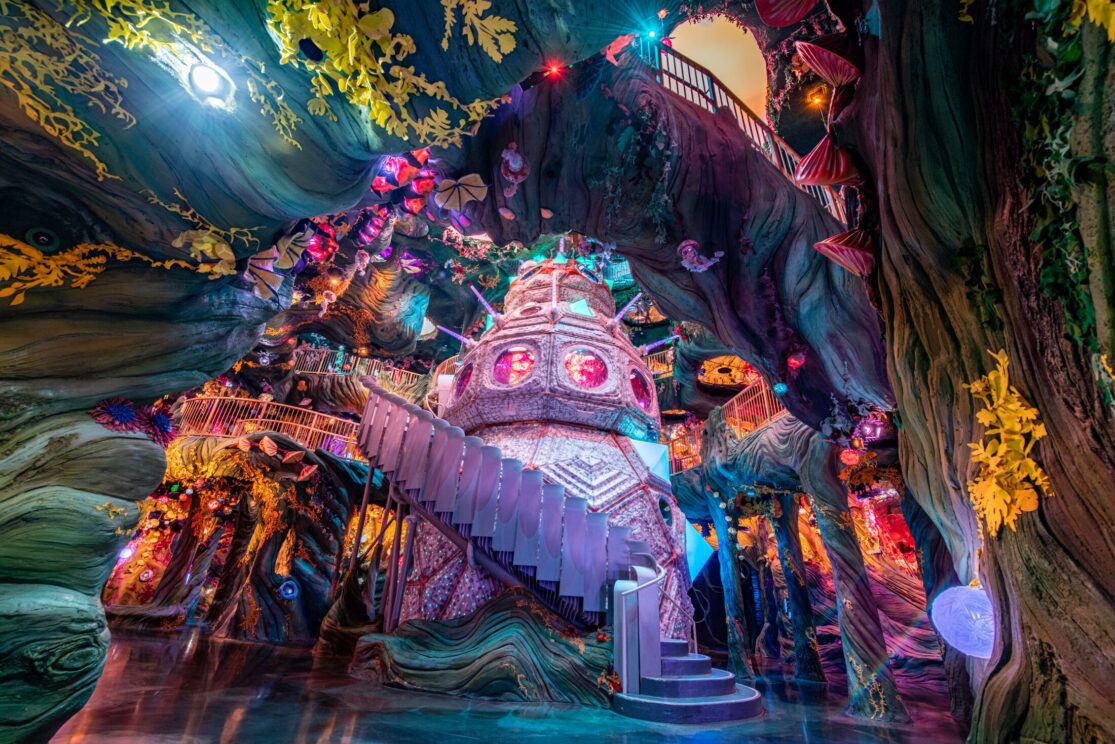
One of the most exciting examples is Meow Wolf, the immersive art collective known for creating surreal interactive environments that blend storytelling, puzzles, music, and visual art. Visitors don’t simply observe the space — they explore it, uncover hidden narratives, and become part of the experience themselves (as shown in the feature image of Meow Wolf Santa Fe’s House of Eternal Return).
Each Meow Wolf installation is entirely unique, and people travel across the country specifically to experience them.
In many ways, it represents exactly where experiential retail is headed: environments that sit somewhere between art installation, entertainment venue, and cultural playground.
Alongside Meow Wolf, HHLA is bringing together other concepts designed around social interaction, entertainment, and exploration — places where people spend time, not just money.
The goal is to create something fundamentally different from the traditional mall model.
The Reinvention of Retail
The internet may be the most efficient store in the world, but it will never be a destination.
For years, the narrative around malls has been that they are dying. I believe the opposite is true. The traditional mall model may be fading, but the physical spaces themselves are more valuable than ever. In a world increasingly dominated by screens, the places that matter most will be the ones that pull people back into the real world.
The future of retail isn’t about selling more things — the internet already does that better than anyone. The future is about building destinations that people can’t download. The developers who understand that won’t just revive retail. They’ll redefine it.
Tyler Mateen is a Los Angeles–based real estate and venture investor, and founder of Cannon TTM.