







































Sponsored by Hootsuite
For most of its history, corporate social media had a fairly straightforward job: post something, schedule something, respond to something, count the likes, repeat. That world is disappearing. Today, social media is simultaneously a customer-service channel, a focus group, a newswire, a competitive-intelligence network, a reputation engine, a cultural barometer and, increasingly, an early-warning system for the entire company. A customer complaint can become a crisis before the communications department has opened its morning email. A meme can change the trajectory of a brand. A competitor can launch a campaign, receive thousands of reactions and effectively conduct a global focus group before lunchtime.
The problem isn’t that companies don’t have enough information. They have too much of it, and not enough time between knowing and doing. That is what makes the next chapter of Hootsuite interesting. The company that became synonymous with social media management is repositioning itself around a significantly larger idea: social shouldn’t simply be managed. It should function as an intelligence system for the business. And Hootsuite has rebuilt its platform accordingly.
Social Is Becoming Corporate Intelligence
The most important idea behind Hootsuite’s evolution may have little to do with social media itself. Social networks collectively represent one of the world’s largest continuously updating datasets of human opinion. People tell the internet what they love, what they hate, what they’re buying, what they’re abandoning, what they’re worried about, which companies disappoint them, which products suddenly matter and what the rest of the world will probably be talking about tomorrow.
For years, businesses largely treated that extraordinary stream of information as a marketing channel. That increasingly looks like a category error. Social data can inform product development, customer service, communications, brand strategy, competitive intelligence and executive decision-making. Hootsuite’s bet is that the social department shouldn’t be the final destination for that intelligence. It should be the beginning.
The challenge, of course, is turning that enormous stream of information into something an organization can actually use. That is where Hootsuite’s transformation from social media management platform to something broader begins to take shape.
From Social Media Manager to Social Operating System
Hootsuite calls its new platform Social OS. The distinction matters. Rather than treating publishing, listening, customer care, analytics and employee advocacy as separate activities, Hootsuite is bringing them into a connected system built around real-time social intelligence and AI. Think of it less as a dashboard for posting to LinkedIn and Instagram and more like a command center sitting between the internet and the organization.
The system is organized around specialized applications. Lumen listens across the digital universe, helping organizations identify conversations, sentiment and narratives as they’re developing. Perch handles content creation, planning and publishing. Nest manages engagement and customer care. Parliament helps organizations turn employees into an amplification and advocacy network.
But perhaps the most interesting layer is Wisdom, Hootsuite’s conversational AI orchestration system. Instead of navigating between tools and dashboards, users can increasingly interact with Hootsuite the way they would interact with an AI assistant: ask a question, get an answer, then act on it. That seemingly small change represents something much larger. If the interface to social intelligence becomes a conversation, the traditional dashboard begins to matter a lot less. Organizations can explore Hootsuite’s evolving social intelligence platform here.
The Death of the Dashboard
For roughly two decades, enterprise software has been organized around dashboards. Every department accumulated them: marketing dashboards, analytics dashboards, social dashboards, CRM dashboards and customer-service dashboards. Then employees became responsible for figuring out what all those dashboards were trying to tell them. Generative AI is beginning to invert that relationship. Instead of humans learning software, software is learning how humans communicate.
Hootsuite’s vision reflects that shift. A marketer might ask what is suddenly trending in an industry. A communications executive might ask how brand sentiment compares with a competitor. A social team could ask for a campaign to be drafted across multiple channels. A customer-care leader could ask to see urgent messages and route angry customers to the appropriate team. The interface becomes conversation. The underlying system handles the complexity. That is a fundamentally different proposition from simply scheduling posts, and becomes invaluable when speed matters.
The Most Valuable Seconds in Marketing
There is another reason this transformation matters: the half-life of relevance is collapsing. Marketing once operated on campaign calendars measured in months. Social operates in minutes. A cultural moment emerges. A conversation spikes. A customer reacts. A competitor makes a mistake. An opportunity appears-and then it disappears. The advantage increasingly belongs to organizations capable of compressing the distance between signal and action.
Hootsuite’s new architecture is designed around exactly that problem. Lumen can identify what’s happening. Wisdom can interpret it. Perch can turn it into content. Nest can manage the response. And the organization can do it without manually handing the information from one disconnected system, or department, to another. That creates something potentially much more valuable than efficiency. It creates organizational reaction time. In an environment where thousands of brands have access to increasingly similar AI tools, reaction time may become one of the few durable competitive advantages left.
But speed inside a single platform only solves part of the problem. For social intelligence to become truly useful across an enterprise, it also has to connect with the systems where the rest of the organization already works.
AI That Doesn’t Live on an Island
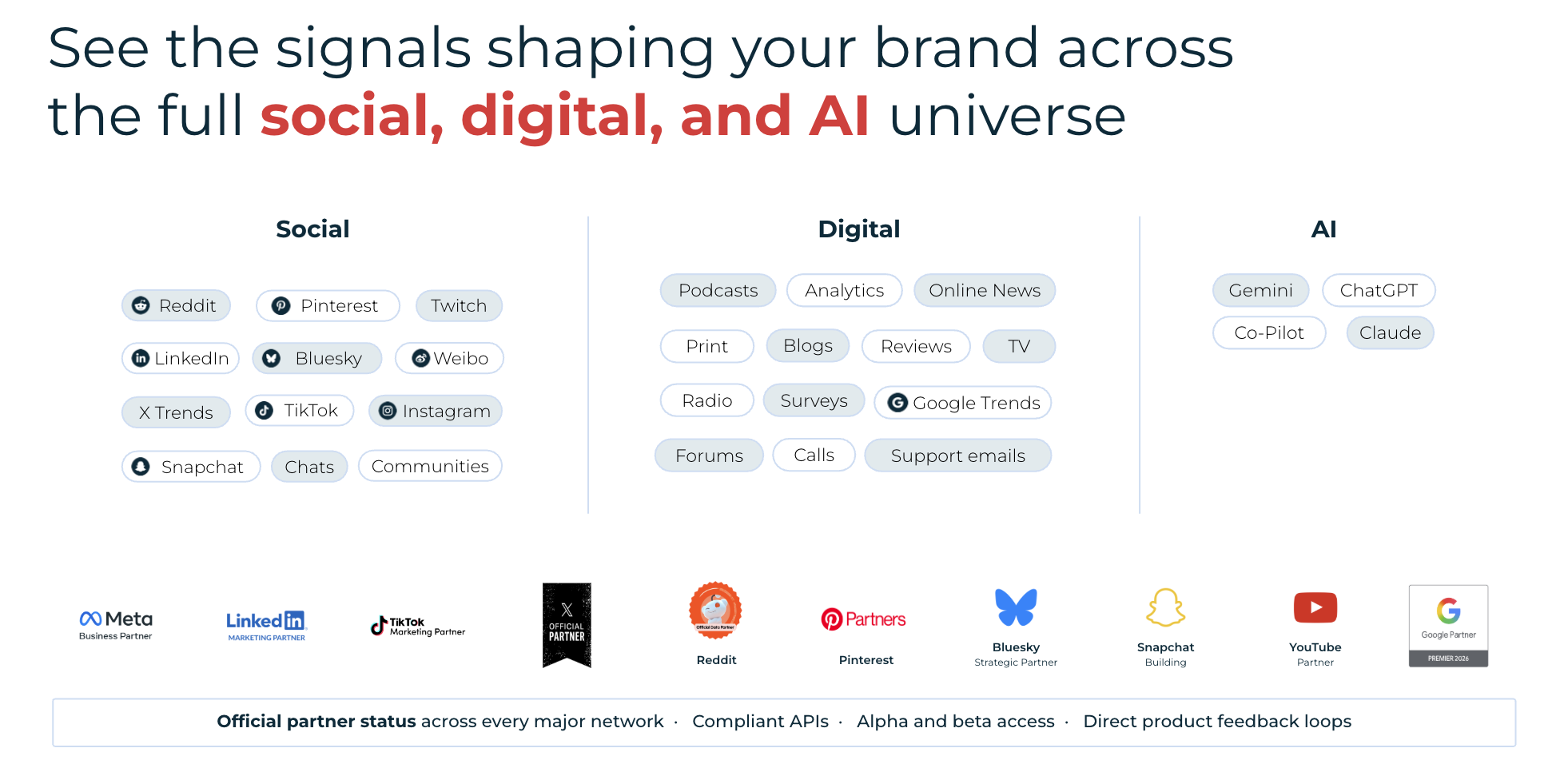
Hootsuite is also embracing another important shift in enterprise AI: interoperability. Through MCP connectors, Hootsuite intelligence can extend into AI environments and tools organizations are already using. That matters because the future of enterprise AI probably isn’t another collection of isolated applications. It’s systems talking to systems. An organization’s social intelligence should be capable of informing the AI tools its employees already use, and outside business information should be able to enrich the intelligence inside Hootsuite.
The result is a more interesting model of enterprise software. Instead of asking employees to constantly visit Hootsuite, Hootsuite can increasingly come to them. And in some ways, that brings the company back to the same problem it was created to solve nearly two decades ago, only at a much larger scale.
Why Hootsuite May Be More Relevant Now Than When Social Media Exploded
There is an irony to all of this. Hootsuite became famous because social media became too important for businesses to manage manually. Now AI is making social media too fast for businesses to manage manually. The problem has changed. So has Hootsuite.
The company’s original value proposition was helping organizations manage an exploding number of social networks. Its emerging value proposition is helping organizations understand, and act upon, an exploding amount of social intelligence. That’s a much larger opportunity. Because the question facing companies today isn’t simply, What should we post? It’s: What is the world telling us right now, and what should we do about it?
The company that can answer both halves of that question may own one of the most important interfaces inside the modern enterprise. Hootsuite has spent nearly two decades sitting on top of the world’s conversations. Now it’s building the intelligence layer designed to do something with them. Explore what Hootsuite is building next.