






































The ERP market has a well-documented problem: implementations that drag on for months, bloated systems that require armies of consultants, and software that forces businesses to work the way the software was designed, not the way the business actually operates.
Intuit Enterprise Suite was built to streamline this implementation.
Backed by Intuit (the company behind QuickBooks, TurboTax, and a decades-long track record in financial software), Intuit Enterprise Suite is an AI-native ERP that brings together multi-entity financial management, intelligent automation, and industry-specific workflows in a single consolidated platform.
The Problem with Traditional ERP Implementations
Ask any CFO who has lived through a traditional ERP implementation and you’ll hear the same story: months of disruption and a system that still requires significant manual workarounds once it’s live.
Intuit Enterprise Suite takes a fundamentally different approach. Using guided onboarding, AI automation, and dedicated support, businesses can migrate in days, not months. The implementation model is designed specifically for low cost and low disruption, so finance teams can get to value fast without taking the business offline.
For organizations that have been putting off modernizing their financial stack because the implementation risk felt too high, this changes the calculus entirely.
One View. Every Entity. In Real Time.
For businesses operating across multiple entities (subsidiaries, divisions, holding companies, or franchises), financial visibility has historically required painful reconciliation work. Spreadsheets, manual eliminations, and delayed reporting.
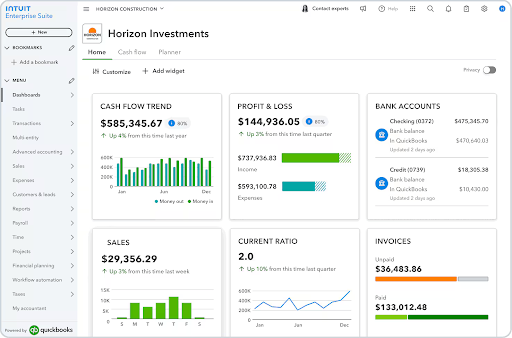
Intuit Enterprise Suite consolidates all of that into a single view.
Finance leaders can see every entity in real time, from revenue to expenses to intercompany activity. Entities can be compared side by side, with full visibility into eliminations and intercompany transactions. And rather than waiting for month-end to understand where the business stands, teams have live access to shared data across the entire organization.
The platform generates consolidated balance sheets, cash flow statements, profit and loss reports, and AP/AR reports with expanded detail, all from one place, without the manual assembly that typically eats up finance team bandwidth.
AI That Does the Work Your Team Shouldn’t Have to Do
The AI capabilities in Intuit Enterprise Suite aren’t marketing language for basic automation. They’re purpose-built financial intelligence designed to handle the specific tasks that slow finance teams down.
The Accounting Agent automates manual bookkeeping work: updating transactions, combining data across sources, and reviewing for inconsistencies. Month-end close happens faster, and with accuracy that holds up to scrutiny.
Beyond the Accounting Agent, Intuit AI handles the workflows that eat up skilled accountants’ time without adding proportional value: chart of accounts standardization, variance detection, and intercompany eliminations. Your team directs the work. Intuit AI executes, and critically, it does so with full rationale and source data your auditors can follow.
For CFOs navigating tighter audit requirements or faster reporting cycles, this combination of speed and accountability is what makes the platform genuinely enterprise-grade.
Built for the Industry You’re Actually In
Generic ERP platforms force businesses to customize their way to industry relevance, an expensive, time-consuming process that creates technical debt and support headaches.
Intuit Enterprise Suite takes a different approach: industry-specific workflows, reports, and dashboards are built in from the start. The platform currently serves more than 20 industries, including construction and nonprofit, two sectors with notably distinct financial management requirements. Construction firms deal with job costing, progress billing, and subcontractor management. Nonprofits require fund accounting, grant tracking, and donor reporting. These aren’t afterthoughts. They’re native capabilities.
This means businesses spend less time configuring the platform to match their operations and more time using it.
The Bottom Line
Intuit Enterprise Suite represents a meaningful shift in what mid-market and enterprise financial management software can look like. The combination of AI-native architecture, multi-entity consolidation, rapid implementation, and industry depth addresses the core frustrations that have made traditional ERP so costly to own and operate.
For finance leaders evaluating their options, the question is no longer whether AI has a role in enterprise financial management. The question is which platform delivers that AI in a way that’s practical, auditable, and built for how real businesses work.
Intuit Enterprise Suite makes a compelling case for itself on all three counts.